Strength of Character: How Proof Became the Ultimate Measure of Premium Whiskey
There was a time, not so long ago, when 80 proof was the unspoken standard — the polite, predictable midpoint around which American whiskey oriented itself. Distilleries bottled to that number almost reflexively, calibrated to a mass market that valued consistency over revelation. Today, that convention has been upended with remarkable speed. Cask-strength releases routinely breach 120, 130, even 140 proof. Overproof expressions carry waitlists. And in certain collector circles, a bottle's ABV has become as consequential a credential as its distillery of origin.
This is not merely a marketing shift. It reflects a deeper transformation in how a growing segment of American whiskey enthusiasts defines authenticity, craftsmanship, and value. Understanding what is driving this phenomenon — and distinguishing genuine quality from theatrical excess — requires a careful look at both the science inside the barrel and the psychology outside it.
What the Barrel Preserves
To appreciate the appeal of cask-strength whiskey, one must first understand what is surrendered in the act of dilution. When a distillery draws spirit from the barrel and adds water to reach a target proof, it is making an editorial decision — one that, in the hands of a skilled blender, can harmonize flavors and soften abrasive edges. But it is an intervention nonetheless, and every intervention carries a cost.
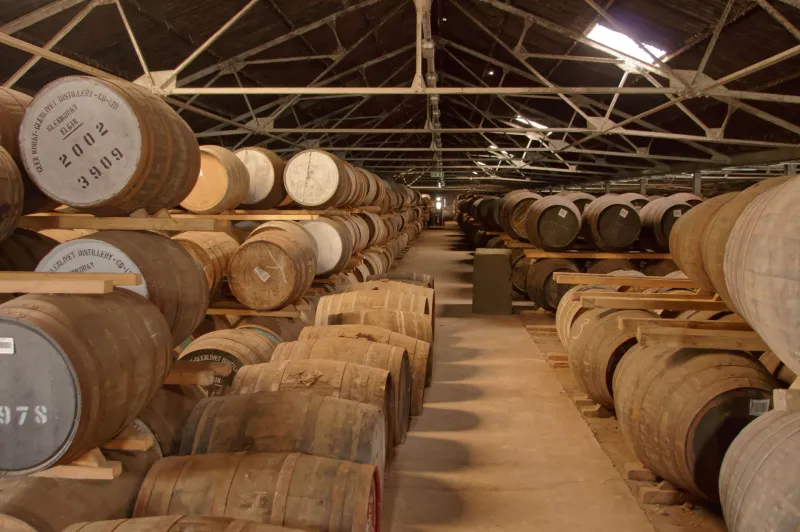
At cask strength, the whiskey arrives in the glass precisely as it emerged from the wood: unfiltered in character, carrying the full concentration of esters, aldehydes, and congeners that accumulated over years of maturation. The aromatic compounds responsible for complexity — vanilla, caramel, dried fruit, baking spice — are present at their most concentrated expression. Tannins extracted from the charred oak are more pronounced. The finish lingers with greater persistence.
Chemistry aside, there is also a practical dimension that collectors find compelling: proof acts as a natural preservative. A bottle of 130-proof bourbon, once opened, will retain its character across weeks or months of intermittent pours in ways that a standard-proof expression simply cannot match. For those who approach whiskey as a long-term investment in sensory experience, this matters considerably.
The Rise of the Proof Premium
The market's appetite for high-proof releases has accelerated dramatically over the past decade, fueled in part by the bourbon boom and in part by a collector culture that prizes scarcity and distinction. William Larue Weller, George T. Stagg, and the broader Buffalo Trace Antique Collection — all uncut, unfiltered expressions — have become the benchmark against which other high-proof releases are measured. Secondary market prices for these bottles regularly reach multiples of their retail value, a testament to demand that far outpaces supply.
Independent bottlers have recognized this appetite and responded accordingly. Small operators acquiring barrels from established Kentucky distilleries frequently bottle at cask strength as a deliberate statement of transparency — an implicit promise that nothing has been hidden or softened. In this framing, proof becomes a proxy for honesty, a signal that the distiller is confident enough in the whiskey's inherent quality to present it without intervention.
Craft distilleries across the country have adopted similar positioning. From craft producers in Texas releasing high-summer barrels at punishing proofs born of accelerated maturation, to small-batch operations in Colorado and Tennessee bottling single-barrel expressions at whatever strength the wood dictates, the message is consistent: this is the whiskey as nature and chemistry intended it.
When Proof Becomes Performance
Not every high-proof release earns its price tag, and it would be a disservice to collectors to suggest otherwise. The same market forces that reward genuine quality also invite opportunism. A whiskey bottled at elevated proof without the underlying complexity to justify it is simply a hotter, harsher version of an unremarkable spirit. ABV, in isolation, proves nothing.
The distinction between a legitimately superior high-proof bottling and a gimmick lies in what the proof reveals rather than what it conceals. A well-matured, cask-strength whiskey uses its strength as a vehicle — delivering layers of flavor that would otherwise dissipate in dilution. A cynical high-proof release uses elevated ABV as a distraction, substituting intensity for depth.
Discerning collectors have grown adept at making this distinction. Tasting notes from respected reviewers, provenance information about the barrel's entry proof and warehouse position, and the distillery's broader track record all factor into the evaluation. The proof on the label is a starting point, not a conclusion.
The Dilution Debate
For every enthusiast who insists on drinking cask-strength whiskey neat, there is a purist who argues that water is not the enemy of quality but its ally. Master distillers with decades of experience will point out that the act of proofing down a whiskey is itself a form of craftsmanship — that finding the precise dilution point at which a spirit's character opens most fully is as demanding a skill as any other in the distillery.
This position is not without merit. Water does more than reduce alcohol; it breaks apart molecular clusters, liberating aromatic compounds that were previously bound to ethanol. A whiskey that seems closed and aggressive at cask strength may reveal unexpected elegance at 100 proof. The practice of adding a few drops of water to a high-proof pour — a ritual familiar to any serious taster — is an acknowledgment that dilution, applied thoughtfully, can be transformative rather than reductive.
The tension between these two philosophies is, in many respects, what makes the current moment in American whiskey so intellectually engaging. Neither camp is entirely wrong. The collector who prizes an uncut expression for its purity is honoring something real. The blender who argues for the artistry of dilution is defending an equally legitimate tradition.
Navigating the High-Proof Landscape
For those approaching this category as collectors or serious enthusiasts, a few principles offer useful orientation. First, prioritize transparency: seek out producers who disclose barrel entry proof, warehouse conditions, and maturation duration alongside the bottling proof. This information contextualizes the ABV and allows for a more informed assessment of whether the strength reflects genuine character or simply aggressive barrel selection.
Second, resist the gravitational pull of novelty. The highest proof available is not automatically the most interesting. Some of the most compelling high-proof releases in recent years have come in at modest cask strength — 110 to 118 proof — where the balance between concentration and approachability yields something genuinely remarkable.
Finally, consider the pour. A cask-strength whiskey tasted in isolation, without the patience to allow it to open in the glass, will rarely reveal its full potential. Add water incrementally. Return to the glass after ten minutes. Allow the spirit to speak on its own terms rather than demanding it perform on yours.
A Measure Worth Taking
Proof has always been a technical specification. What is new is its elevation to a cultural signal — a shorthand for authenticity, seriousness, and the willingness to engage with whiskey on its most uncompromising terms. That elevation reflects something genuine about where American spirits culture has arrived: more informed, more demanding, and more willing to reward producers who treat the barrel as a complete statement rather than a starting point for intervention.
The proof problem, properly understood, is not a problem at all. It is an invitation — to look more closely, taste more carefully, and approach the glass with the same precision and curiosity that the finest distillers bring to their craft.