Training the Senses: What Master Blenders Know About Tasting That Most Drinkers Never Will

There is a particular kind of silence that descends in the moments after a truly exceptional spirit crosses the palate. It is not the silence of emptiness. It is the silence of attention — the mind stilling itself so that the senses can complete their work. Master blenders know this silence intimately. For them, it is not an accident of enjoyment but a cultivated professional state, one that takes years, sometimes decades, to achieve with any reliability.
For the serious enthusiast, understanding how to arrive at that state — and what to do once you are there — is among the most rewarding pursuits in the world of premium spirits. The good news is that the process is learnable. The neuroscience of flavor perception, combined with the structured habits employed by professional evaluators, offers a genuine roadmap for anyone willing to slow down and pay attention.
The Neuroscience Beneath the Nose
Flavor, as neuroscientists have established, is not a property of the liquid in the glass. It is a construction of the brain — an elaborate synthesis of olfactory data, taste receptor signals, tactile sensations, and even visual and auditory cues. What we experience as the "taste" of a single-barrel bourbon or a well-aged Scotch is, in reality, the product of hundreds of simultaneous inputs being processed, filtered, and assembled into a coherent perception.
The olfactory system is central to this process. Roughly eighty percent of what we perceive as flavor arrives through the nose, both directly and retronasally — that is, through the passage at the back of the throat that connects the mouth to the nasal cavity. This is why a stuffed nose renders even the most complex spirit flat and unremarkable. It is also why master blenders spend as much time developing their sense of smell as they do refining their palate in the traditional sense.
Professional blenders at major distilleries often maintain strict protocols around nasal hygiene and environmental control. They avoid strong fragrances, spicy foods, and even coffee before formal evaluation sessions. These are not affectations. They are practical acknowledgments of how easily the olfactory system can be primed, fatigued, or misled.
The Architecture of a Proper Evaluation
Casual drinkers typically pour, swirl once or twice, and drink. The entire sensory sequence collapses into a single undifferentiated experience. Professional tasters, by contrast, approach each spirit as a structured series of distinct observations, each one building on the last.
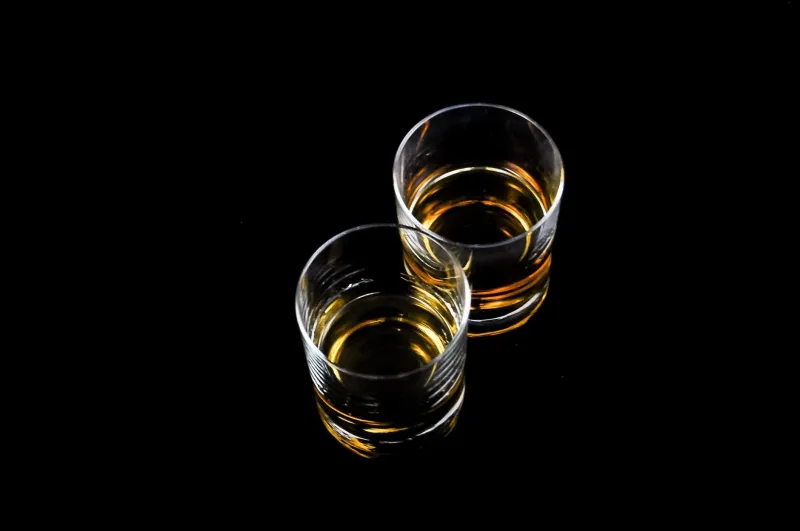
Rest the spirit before engaging it. Pour your measure — one to one and a half ounces is standard for evaluation — and allow it to sit in the glass for three to five minutes. This brief resting period allows volatile compounds to settle into a more stable aromatic profile and permits the alcohol to partially dissipate from the surface, reducing the harsh burn that can overwhelm subtler notes on first nosing.
Nose at a distance before nosing close. Begin with the glass held several inches below the nose, breathing naturally rather than inhaling deeply. This captures the most volatile, high-toned aromatics — often floral, fruity, or grain-forward compounds — without triggering the olfactory fatigue that comes from an aggressive initial nosing. Only after this preliminary impression should you bring the glass closer, tilting it slightly to concentrate the aromatic column.
Nose with your mouth open. This counterintuitive technique, standard practice among trained evaluators, allows retronasal engagement even before the spirit is tasted. The warmth of the breath interacts with the aromatic compounds in ways that a closed-mouth nosing cannot replicate, revealing deeper, earthier, or more resinous notes that would otherwise remain hidden.
Sip deliberately and let the spirit rest on the palate. Rather than swallowing immediately, allow a small sip to spread across the entire tongue. Different regions of the palate register different taste qualities — sweetness toward the front, bitterness toward the back, salinity along the sides. A spirit that seems one-dimensional when swallowed quickly may reveal considerable complexity when given time to travel.
Attend to the finish with equal seriousness. The retronasal impression that emerges after swallowing — the so-called finish — is where many premium spirits distinguish themselves most clearly. A short, clean finish signals one thing; a long, evolving finish that shifts from sweet to spicy to woody tells an entirely different story. Master blenders often regard the finish as the most diagnostic phase of any evaluation.
Developing a Flavor Vocabulary
One of the most significant barriers separating enthusiastic amateurs from professional evaluators is not sensory acuity — it is language. The ability to name what one is perceiving is not merely a communication tool. Research in cognitive psychology suggests that having precise language for a sensation actually sharpens the perception itself. The act of naming focuses attention and creates memory anchors that make future comparisons more reliable.
The standard approach among professional tasters is to build a flavor library through deliberate cross-referencing. When a bourbon presents a note that seems familiar but elusive, the discipline is to pursue that reference rather than accept the vague impression. Is it vanilla extract or vanilla bean? Dried cherry or fresh cherry? Dark chocolate or baker's cocoa? These distinctions matter, and the practice of chasing them trains the brain to parse aromatic complexity with increasing precision over time.
One practical exercise borrowed from professional sensory training involves nosing common pantry ingredients — cinnamon sticks, dried fruit, toasted oak chips, leather, dried herbs — in isolation, then attempting to identify them blind. The goal is not to become a chemist but to build a mental catalog of reference points that can be called upon during actual evaluation sessions.
The Psychological Discipline of Tasting
Beyond the sensory mechanics, there is a psychological dimension to serious tasting that rarely receives adequate attention. Confirmation bias is among the most persistent obstacles to honest evaluation. When a bottle carries a prestigious label, a high auction price, or the endorsement of a respected critic, the brain is powerfully inclined to find the qualities it has been told to expect. This is not weakness of character — it is simply how perception works under conditions of expectation.
Master blenders routinely conduct internal evaluations blind, or at minimum, work to suspend prior knowledge during the evaluation phase. For the private enthusiast, building a habit of forming initial impressions before consulting tasting notes or scores is a meaningful step toward more honest self-assessment. The goal is not to distrust expertise but to develop the confidence to trust one's own perceptions as a legitimate data point.
Patience, too, is a psychological skill. The instinct to reach a verdict quickly — to decide whether a spirit is good or not within the first thirty seconds — is antithetical to serious evaluation. Some of the most complex and rewarding expressions in any category reveal themselves slowly, across multiple sips and across the full duration of the glass. Allowing a spirit the time it requires is itself an act of respect, and one that is consistently rewarded.
The Practice That Makes the Palate
There is no shortcut to a sophisticated palate. The master blenders who shape the world's most celebrated spirits have spent careers in deliberate, structured engagement with their craft. What they possess is not a gift so much as an accumulation — of reference points, of disciplined attention, of the willingness to sit with complexity rather than resolve it prematurely.
For the connoisseur willing to bring that same spirit of inquiry to the glass, the rewards extend well beyond the ability to describe a spirit more precisely. The practice transforms the act of tasting into something closer to what it deserves to be: a genuine encounter with craft, time, and the particular intelligence of distillation at its finest.