The Second Vessel Problem: How Decanters Quietly Betray the Spirits They're Meant to Honor
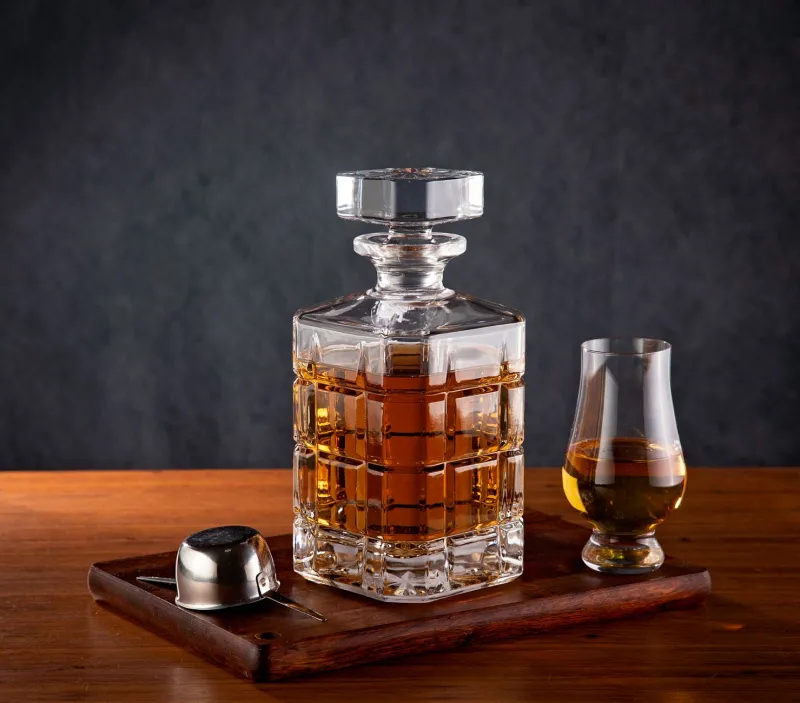
There is a certain ritual satisfaction in lifting a rare whiskey from its original packaging and settling it into a handsome crystal decanter — the kind that catches candlelight and announces, without a word, that the person pouring from it has taste. It is a gesture that feels like an upgrade. In nearly every meaningful chemical sense, it is not.
For collectors who have spent years — and considerable sums — assembling a serious collection of American whiskey, Scotch, or aged rum, the question of secondary vessels deserves far more scrutiny than it typically receives. The original bottle, for all its marketing and branding, is also a precisely engineered containment system. The decanter, however beautiful, is frequently none of those things.
Surface Area and the Quiet Aggression of Oxygen
The first mechanism of damage is the most familiar, yet its scale is routinely underestimated. When a spirit is transferred from its original bottle into a decanter — particularly one with a wide bowl or a broad shoulder — the ratio of liquid surface area to total volume increases substantially. Oxygen, which was previously interacting with the spirit only along a relatively narrow neck, now has a far more generous interface.
Oxidation is not inherently destructive. In the original bottle, a controlled and gradual exposure to trace oxygen can soften harsh edges over time, a phenomenon that has led to the popular notion that an opened whiskey "opens up" across weeks or months. That process, however, depends on a specific and limited exchange. In a wide-mouthed decanter that is opened regularly and left partially filled, the same chemical reactions accelerate dramatically. Esters — the aromatic compounds responsible for fruit, floral, and spice notes — are among the first casualties. What once expressed itself as dried cherry or candied orange peel may, within weeks, flatten into something indistinct and dull.
For a spirit acquired at secondary market prices, that transformation represents not merely a sensory disappointment but a measurable loss of value.
The Stopper Question: Crystal, Cork, and the Illusion of Seal
Original distillery bottles are typically sealed with corks or synthetic closures engineered to specific tolerances, tested against the spirit's proof and chemistry. A crystal decanter stopper, by contrast, is designed primarily for visual harmony. The ground glass fit that feels satisfying to the hand and elegant on a sideboard offers a seal that is, at best, approximate.
This matters for two reasons. First, an imperfect stopper allows for continuous, uncontrolled vapor exchange. Volatile aromatic compounds — the very elements that give a premium spirit its nose and much of its perceived complexity — escape through gaps that are invisible to the eye but entirely permeable to molecules. Second, and less discussed, is the question of humidity. In dryer climates or during winter months when indoor heating reduces ambient moisture, an imperfect seal can permit enough evaporation to alter proof over extended periods.
Some collectors test decanter stoppers by applying a thin film of neutral food-grade oil to the ground glass surface before seating the stopper, creating a marginally better seal. This is a reasonable precaution, though it does not fully compensate for what a precision-engineered original closure provides.
Cork-stoppered decanters introduce a separate concern. Cork is a living material, and its interaction with high-proof spirits — particularly anything above 100 proof — can accelerate degradation of the cork itself, introducing tannins and off-notes that have no place in a carefully aged whiskey. If a decanter employs a cork stopper, it should be inspected regularly and replaced at any sign of deterioration.
Light: The Underestimated Accelerant
Decanting a spirit into a clear crystal vessel and placing it on a lit bar shelf or near a window is, from a preservation standpoint, one of the more damaging choices a collector can make. Ultraviolet light catalyzes photochemical reactions in spirits that are chemically analogous to what happens when wine is "light struck." Specific congeners — including certain sulfur compounds and some phenolic elements — react under UV exposure to produce off-flavors that are difficult to detect until they are already well established.
Original distillery bottles are often tinted, frosted, or at minimum stored in secondary packaging precisely because the producers understand this risk. A gleaming crystal decanter on open display offers no such protection.
For collectors who favor the aesthetic of displayed spirits, dark or tinted decanters offer a partial solution. Keeping decanters in enclosed cabinetry with limited ambient light exposure is a more complete one. The goal is to replicate, as closely as possible, the controlled darkness that defines proper spirits storage — the same logic explored in the science of cellar conditions that serious collectors already apply to their unopened inventory.
When Decanting Is Appropriate
None of this is to suggest that decanters serve no legitimate purpose. For spirits intended for near-term consumption — a bottle opened for a gathering, a whiskey being actively explored across a week or two — a quality decanter with a well-fitted stopper is entirely appropriate and presents no meaningful risk. The aesthetic pleasure it affords is genuine, and for spirits consumed within a short window, the chemistry of degradation is largely irrelevant.
The calculus changes entirely for bottles of collector-grade significance: limited releases, distillery exclusives, single-barrel expressions with documented provenance, or any spirit acquired at a price that reflects its rarity rather than merely its retail positioning. These bottles are best left in their original containers, stored correctly, and opened on occasions that justify the decision.
If a collector wishes to display a prized spirit, a sealed original bottle — ideally in a case or enclosed cabinet — serves the purpose without exposing the liquid to the variables that a secondary vessel introduces. The bottle itself is part of the artifact's identity.
The Collector's Honest Accounting
The premium spirits market has matured considerably in the United States over the past decade. Secondary market prices for allocated American whiskey, rare single malts, and aged agricole rum now routinely surpass those of fine wine and approach the territory of vintage champagne. At those price points, the decisions made after acquisition matter as much as the acquisition itself.
A decanter is not neutral. It is a vessel with its own chemistry, its own tolerances, and its own relationship to the spirit it holds. Understanding that relationship — rather than assuming that beauty and function are synonymous — is precisely the kind of discernment that separates a collector from someone who merely accumulates bottles.
At Baron Spirits, the premise is straightforward: rare spirits deserve the same rigorous attention to their preservation as they receive to their selection. The second vessel, chosen carelessly, can undo what the first vessel protected for years. That is not a minor footnote. It is the difference between what you paid for and what you eventually pour.